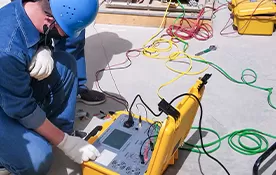
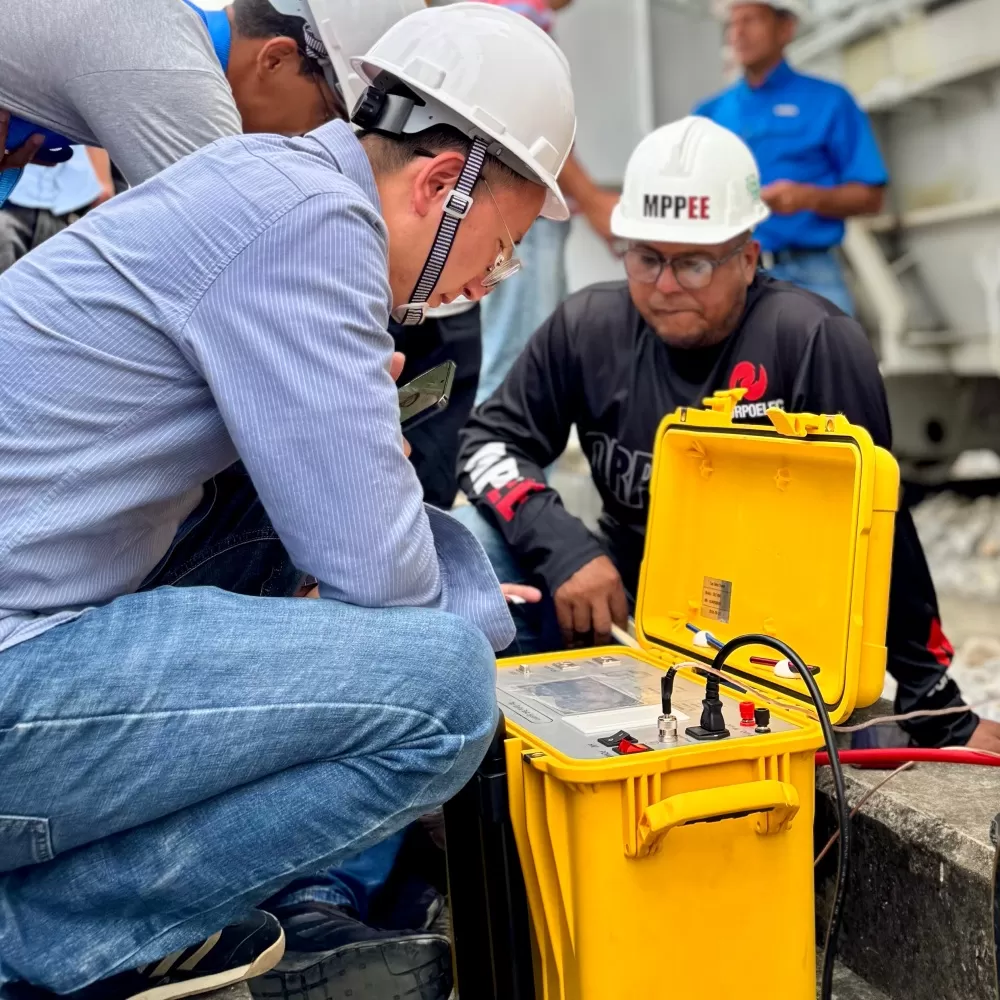
Insulation resistance testing is one of the most important safety checks for electrical installations, cables, transformers, switchgear, motors, and high-voltage equipment. It helps engineers identify insulation aging, moisture, contamination, leakage paths, and possible breakdown risks before a failure occurs.
For contractors, utilities, substations, industrial plants, and maintenance teams, understanding the insulation resistance test IEC standard is essential for selecting the right DC test voltage, judging results correctly, and choosing reliable test equipment. Elecgene provides professional electrical testing instruments for insulation testing, transformer testing, power protection testing, and power system maintenance.
What Is the Insulation Resistance Test IEC Standard?
The insulation resistance test IEC standard refers to IEC-based requirements and methods used to verify whether electrical insulation can resist leakage current under a specified DC test voltage.
In an insulation resistance test, a DC voltage is applied between live conductors, or between live conductors and earth, while the tester measures resistance in MΩ, GΩ, or TΩ. A higher value usually means better insulation condition. A low or unstable value may indicate moisture, damaged insulation, contamination, cable aging, or unsafe leakage paths.
For low-voltage electrical installations, IEC 60364-6 is one of the key references for verification. For insulation resistance measuring instruments, IEC 61557-2 specifies requirements for equipment used to measure insulation resistance in de-energized installations and equipment. For machine electrical systems, IEC 60204-1 is also commonly referenced.
The circuit should normally be de-energized, isolated, and checked before testing. Sensitive electronics, surge protective devices, drives, sensors, and control modules may need to be disconnected or protected before applying a high DC test voltage.
Which IEC Standards and Test Values Should Be Compared?
IEC insulation resistance test values compare nominal circuit voltage, DC test voltage, and minimum acceptable insulation resistance for a specific installation or equipment type.
The correct IEC standard depends on the object being tested. A building distribution circuit, a machine control cabinet, and a transformer insulation system may require different procedures, test voltages, and acceptance criteria.
| IEC Reference | Main Scope | Typical Use | Practical Note |
|---|
| IEC 60364-6 | Low-voltage electrical installations | Verification of installation insulation resistance | Common for contractors, buildings, plants, and commissioning |
| IEC 61557-2 | Insulation resistance measuring equipment | Requirements for insulation resistance testers | Important when selecting compliant test instruments |
| IEC 60204-1 | Electrical equipment of machines | Machine electrical safety verification | Common for machine builders and automation systems |
For low-voltage installation verification, IEC 60364-6 gives widely used reference values:
| Nominal Circuit Voltage | DC Test Voltage | Minimum Insulation Resistance |
|---|
| SELV and PELV | 250 V DC | 0.5 MΩ |
| Up to and including 500 V, including FELV | 500 V DC | 1 MΩ |
| Above 500 V | 1,000 V DC | 1 MΩ |
These values are minimum verification references, not always ideal maintenance targets. In real field maintenance, a healthy cable, transformer, or switchgear system may show much higher readings, often hundreds of MΩ or several GΩ depending on equipment type, length, insulation material, temperature, and humidity.
How Should an IEC-Based Insulation Resistance Test Be Performed?
An IEC-based insulation resistance test is performed by isolating the circuit, applying the correct DC test voltage, measuring resistance between defined points, and recording whether the result meets the required limit.
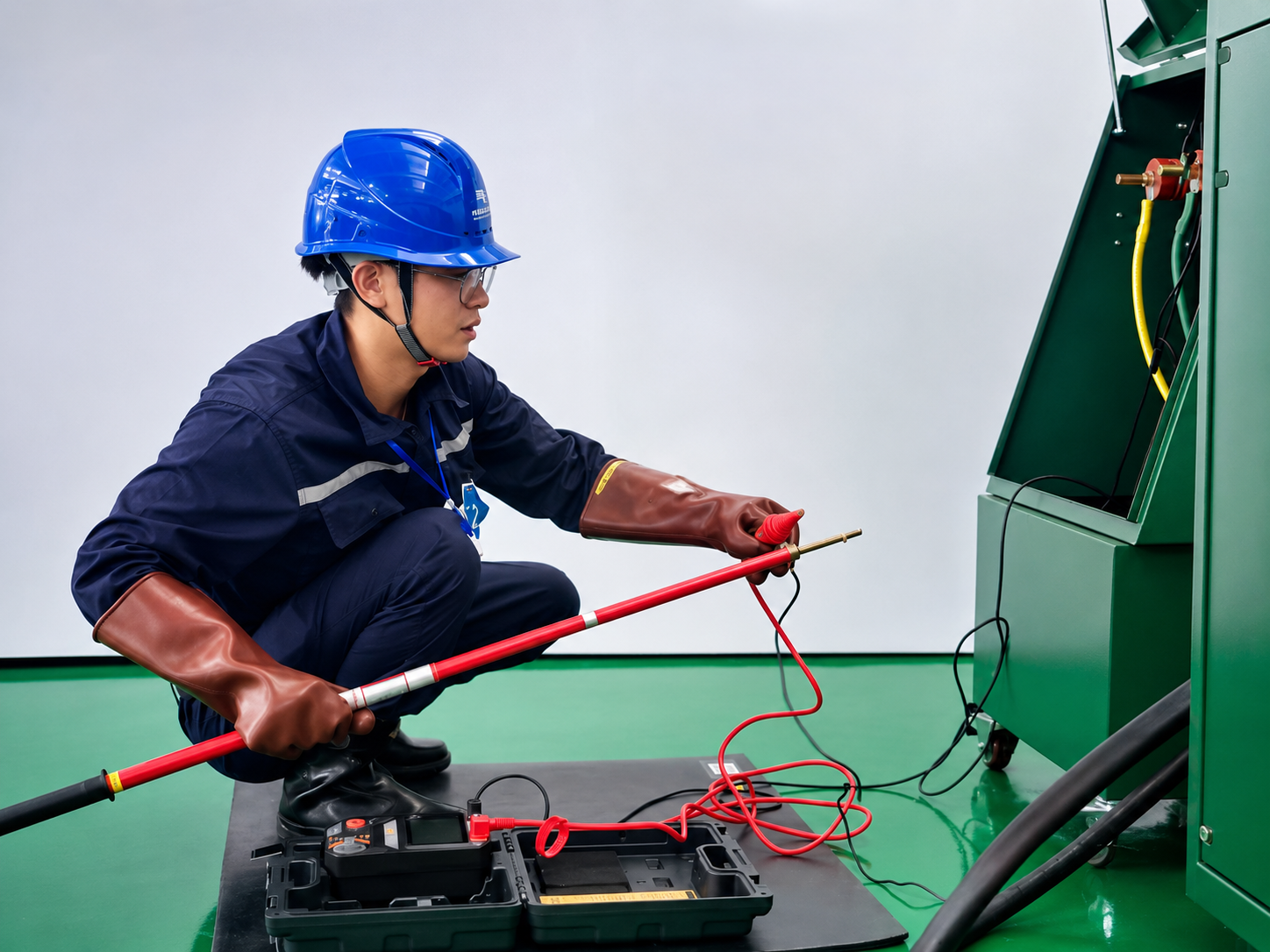
Before testing, disconnect the circuit from power and confirm it is de-energized. The engineer should identify the correct test points, confirm the applicable IEC or project requirement, remove sensitive electronic loads if necessary, and select the proper DC test voltage.
For many low-voltage installation tests, live conductors may be connected together and tested against the protective conductor or earth. This helps avoid applying the test voltage across sensitive connected loads. After the voltage is applied, the reading should be allowed to stabilize before being recorded.
For high-voltage assets, insulation resistance testing is often more than a simple pass-or-fail check. Engineers may use time-resistance curves, dielectric absorption ratio (DAR), polarization index (PI), step voltage testing, dielectric discharge (DD), and ramp testing to understand insulation condition more deeply.
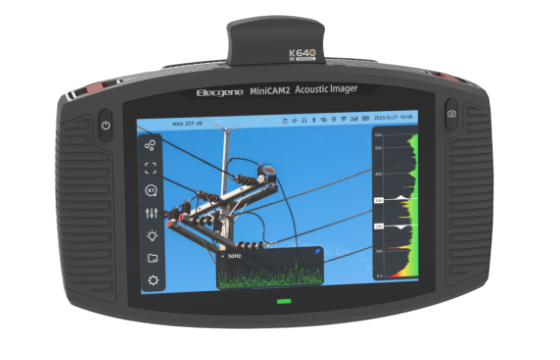
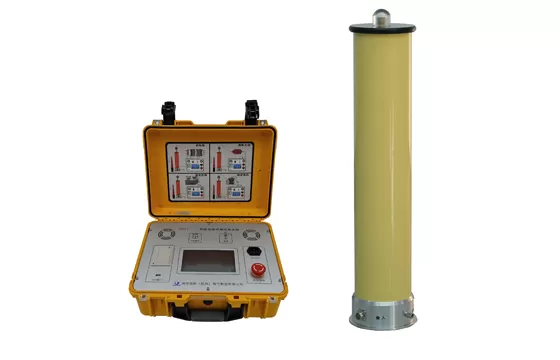
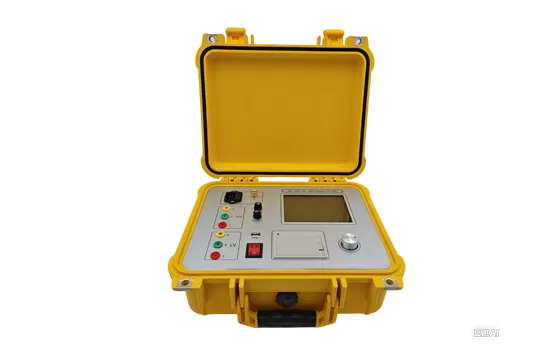
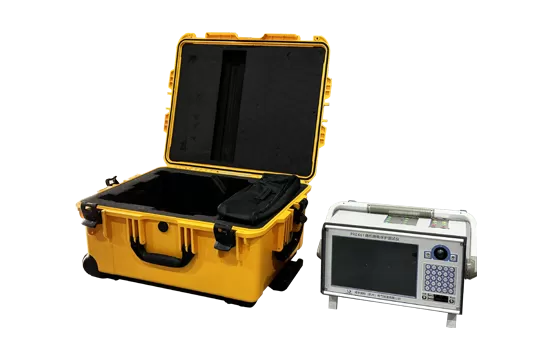
Elecgene's insulation test equipment range is designed for transformers, cables, switchgear, substations, industrial plants, and power maintenance teams that need reliable insulation diagnosis rather than only basic resistance readings.
How Can Elecgene Help Engineers Choose the Right Insulation Tester?
Choosing the right insulation tester means matching the test voltage range, resistance range, safety level, diagnostic functions, and reporting needs to the actual electrical asset.
For basic low-voltage installation checks, a tester that supports 250 V, 500 V, and 1,000 V DC may be enough. For substations, utilities, large industrial facilities, and high-voltage equipment, engineers often need higher voltage output, stronger noise rejection, stable readings, long-time recording, and diagnostic test modes.
The Elecgene D1110 high-voltage digital insulation tester supports output voltage from 100 V to 12,000 V, resistance measurement from 10 kΩ to 35 TΩ, and test modes including IR, IR(t), DAR, PI, SV, DD, ramp test, and voltage measurement. It also supports real-time voltage, current, and resistance display, with data export for maintenance reporting.
This makes Elecgene suitable for insulation evaluation of transformers, breakers, cables, and other primary electrical equipment. For teams that need IEC-based field testing, Elecgene can provide product selection support through the Contact Us page.
Conclusion
The insulation resistance test IEC standard provides a practical framework for checking electrical insulation safety and reliability. IEC 60364-6 helps define common low-voltage installation test voltages and minimum resistance values, IEC 61557-2 supports instrument selection, and IEC 60204-1 is relevant for machine electrical equipment.
However, insulation resistance testing should not be treated as a single-number judgment. Reliable results depend on correct isolation, suitable test voltage, stable readings, environmental conditions, historical comparison, and proper documentation. For professional insulation diagnosis in power systems, Elecgene offers insulation testing solutions for cables, transformers, switchgear, substations, and industrial electrical maintenance.
FAQ
1. What is the IEC standard for insulation resistance testing?
Commonly referenced IEC standards include IEC 60364-6 for low-voltage electrical installations, IEC 61557-2 for insulation resistance measuring equipment, and IEC 60204-1 for electrical equipment of machines. The correct standard depends on the tested object.
2. What is the minimum insulation resistance under IEC 60364-6?
For many low-voltage installation checks, IEC 60364-6 uses 0.5 MΩ at 250 V DC for SELV and PELV circuits, 1 MΩ at 500 V DC for circuits up to and including 500 V, and 1 MΩ at 1,000 V DC for circuits above 500 V.
3. Is 1 MΩ always enough?
No. 1 MΩ is a common minimum value for certain installation verification tests, but it is not a universal target for every asset. Cables, transformers, motors, and switchgear should also be judged by equipment rating, history, environment, and manufacturer recommendations.
4. Why is DC voltage used in insulation resistance testing?
DC voltage is used because it allows the tester to measure leakage current through insulation and calculate resistance. DC insulation resistance test is also useful for observing insulation absorption behavior in diagnostic tests such as PI and DAR.
5. Can insulation resistance testing damage equipment?
Yes, if the wrong test voltage is selected or sensitive electronics remain connected. Before testing, engineers should isolate the circuit and protect devices such as drives, sensors, control boards, surge protective devices, and communication modules.
6. How do I choose an IEC insulation resistance tester?
Select the tester according to asset voltage, required DC test voltage, resistance range, accuracy, safety category, data recording needs, and diagnostic functions. For high-voltage equipment, models with PI/DAR, ramp test, noise rejection, and report export are more suitable.

 English
  日本語
日本語  한국어
한국어  français
  Deutsch
  русский
  português
  العربية